Taking notes at local meetings keeps both civilians and future journalists informed
By ADDIE TILLER
Documenters Canada is expanding its network of meeting note takers to boost scrutiny of civic affairs at a time when local news outlets are struggling to get the job done.
Documenters Canada, which pays people to attend and take notes at public meetings, launched in 2024 with The Green Line, a Toronto-based publication. After expanding its network to include news outlets in Montreal and, soon, Crowsnest Pass, Alta., the project is also incorporating journalism students on its roster of note-takers.
The Documenters Network originated in Chicago in 2015 when a news outlet teamed up with citizens to sit in on police accountability meetings and share information. The collaboration between journalists and citizens was effective. After being fact-checked, Documenters’ notes are shared online for free consumption and, in some instances in the United States, are the impetus for further stories.
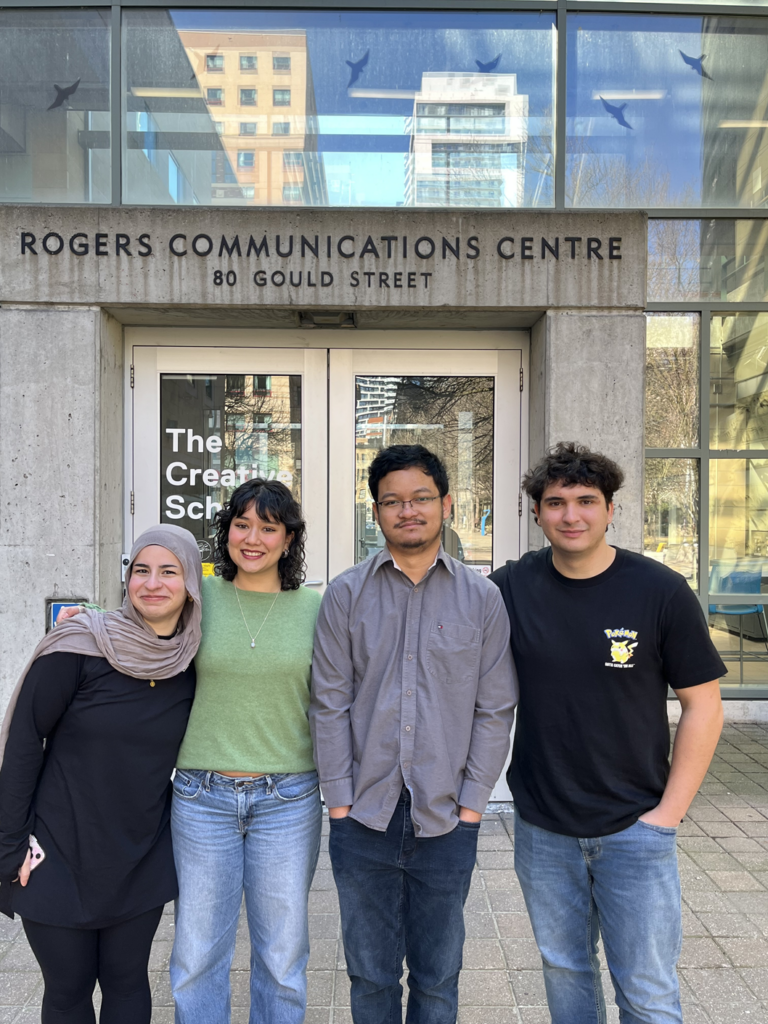
Through associate professor Nicole Blanchett’s class, Reimagining the News, four Toronto Metropolitan University (TMU) students chose to participate in the Documenters project in the Winter 2026 semester for course credit. Three students summarized local meetings, highlighted key takeaways and their observations, and listed fact-checking sources for the Documenters Canada website. They took notes at meetings including the Weston chapter meeting of the Association of Community Organizations for Reform Now (ACORN) and a Toronto city council executive committee meeting.
The fourth student, Aia Jaber, acted as the community engagement lead for the class. Jaber, who is also a research assistant on the Documenters project and the community engagement lead for The Green Line, held discussions with students about which meetings they planned to attend, reviewed item agendas with them, fact-checked the other students’ notes and posted them to the Documenters Canada site.
“All meetings are good meetings so long as there is a call to action or some kind of opportunity for the public to be a part of the conversation,” says Jaber.
As Blanchett, one of the co-directors and researchers working on the Documenters Canada expansion, prepared for the course, she considered how apt the documenting process would be for her class and also decided to assume the role of newsroom editor who would have final say in what was published.
“The whole point of Reimagining News is trying things outside of traditional journalistic boundaries and seeing if there’s different ways we can share information,” she says. “[Documenting is] similar to journalism, but still slightly different because the whole idea isn’t that you have a story, so to speak. The idea is that you’re just there as someone in the room to be keeping an eye on what’s happening.”
Blanchett says due to a lack of resources, journalists typically aren’t at community-level meetings or even the meetings leading up to a city council vote. Reimagining the News students observed this firsthand.
Third-year student Christian Malong, who focused on health and housing meetings, said he was the only audience member at a Toronto Community Housing Corporation meeting held in February.
“I think traditional journalism might miss some of these smaller things, even though they’re important to the everyday lives of some Torontonians,” he said.
Emma Amodio, a Master of Journalism student, also documented issues affecting residents’ day-to-day lives. She was curious about how the city and neighbourhoods were preparing to host the 2026 FIFA World Cup.
Amodio attended a Kensington Market BIA meeting and Toronto city council’s executive committee and FIFA World Cup 2026 subcommittee meetings. She says she now understands things like procurement plans and when agenda items are published. She’s also acquired skills she can apply to her journalism practice.
“My ability to discern what information people are actually interested in has strengthened a lot,” Amodio said.
Documenting, she added, is a form of “unpretentious,” “extremely accessible,” community-oriented journalism that “provides information the community has a stake in.”
Jack Cochrane said his goal as a Documenter was to make information about access to housing more available and to distill complex housing jargon into information tenants could easily understand. He focused on ACORN, a multi-chapter union advocating for low- and moderate-income people. Cochrane attended ACORN Weston, Downtown Toronto and East Hamilton chapter meetings that centred around tenant rights.
Cochrane said the systems that govern tenant rights and housing can be confusing, and tenants might have a hard time navigating issues. He says that’s why he wanted to get housing information into “more people’s hands.”
Malong also observed that the information he obtained in public meetings was pertinent. He went to a Toronto Community Housing Corporation tenant services committee meeting where a deputant raised concerns about ineffective air conditioning in Toronto Community Housing properties. In his Documenter notes, Malong recorded the deputant’s prediction that 2026 will be potentially even hotter than last year.
In speaking about the importance of publishing notes like these, Malong said, “It’s easier for the public to advocate for themselves if they know exactly what’s going on.” If someone learns about their neighbour suffering in extreme heat, he added, they will be more likely to complain to an elected official about it.
Attending municipal and civic meetings had an impact on the Reimagining the News students.
“Becoming a Documenter allows you to feel like you’re making a real tangible difference because it’s so hyperlocal, you can focus on issues at a neighbourhood level with real community members, sit there and engage with them, hear what they have to say about it, and then bring that into a written format,” Amodio said. “It’s been really rewarding for me to engage with people on that level.”
Next steps in the Documenters Canada expansion include ongoing research by Blanchett, her co-director Magda Konieczna from Concordia University and co-investigator Tyler Nagel from Southern Alberta Institute of Technology. They’re examining the challenges and benefits of having Documenters working in municipal environments, and how their notes might be better integrated into local journalistic output.